Is Work From Home Mandatory After Maternity Leave in India?
An employee completes her maternity leave and requests six additional months of work from home. Can the employer refuse? Does India's new Labour Code make remote working compulsory after maternity leave?
These are important questions for working mothers, HR professionals and employers navigating India's updated labour law framework.
Quick answer: No. Work from home (WFH) is not automatically mandatory after maternity leave in India.
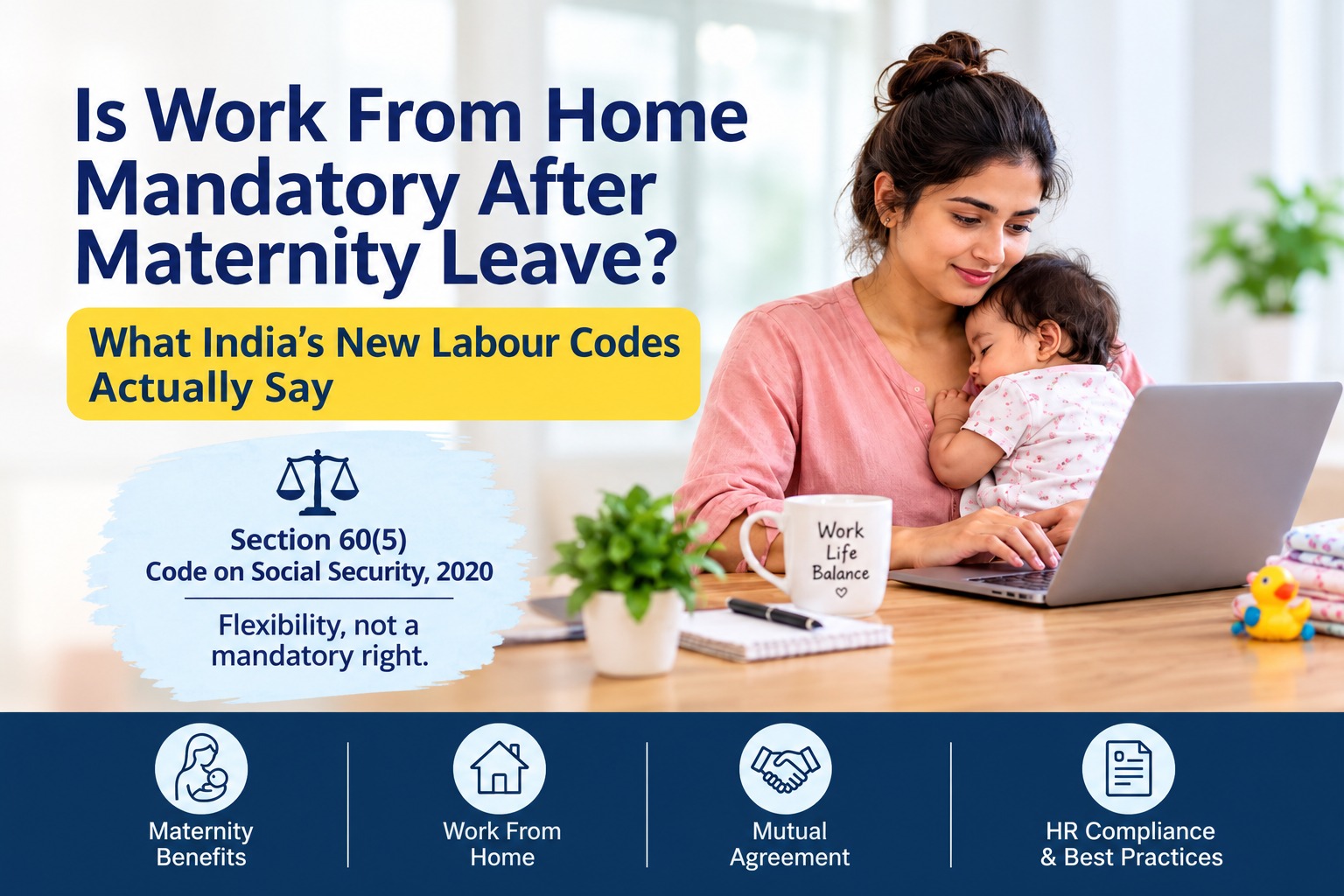
Section 60(5) of the Code on Social Security, 2020, allows an employer to permit work from home after maternity benefit is availed when the nature of the employee's work permits it. The duration and conditions must be mutually agreed upon by the employer and the woman employee.
Understanding this provision helps organisations handle maternity-related requests fairly while balancing employee needs, job responsibilities and business operations.
What Do India's New Labour Codes Say About WFH After Maternity Leave?
India's four Labour Codes came into effect on 21 November 2025, according to the Ministry of Labour and Employment. The Code on Social Security, 2020, contains the maternity benefit provisions relevant to this question.
Under Section 60(5), an employer may allow a woman employee to work from home after she has availed herself of maternity benefit if the work assigned to her is of a nature that can be performed remotely.
The provision identifies three key considerations:
- Nature of the work: The employee's duties must be suitable for remote working.
- Employer's decision: The law permits the employer to allow WFH; it does not automatically require approval.
- Mutual agreement: The duration and conditions of the arrangement must be agreed upon by the employer and employee.
For example, a payroll executive who can securely access the required systems and complete her responsibilities remotely may be suitable for a WFH arrangement. An employee whose essential duties require physical presence at a manufacturing facility or operational site may not be able to perform the same work from home.
The decision should be based on the actual responsibilities of the role, operational feasibility and applicable legal obligations.
Official reference: The Code on Social Security, 2020 — Ministry of Labour and Employment.
Is Work From Home a Legal Right After Maternity Leave?
Section 60(5) provides a mechanism for post-maternity work-from-home arrangements, but it does not establish an unconditional right to remote work for every eligible employee.
The distinction is important:
| Question | What the law provides |
|---|---|
| Is WFH automatically compulsory after maternity leave? | No. |
| Can an employer permit WFH? | Yes, if the nature of the assigned work permits it. |
| Is there a fixed statutory WFH period after maternity leave? | Section 60(5) does not prescribe a universal duration. |
| Must the arrangement's conditions be agreed upon? | Yes. The duration and conditions are subject to mutual agreement. |
| Does the provision apply to every job role? | No. The nature of the work is a relevant condition. |
The provision should not be interpreted as either a blanket obligation on employers to approve every request or a reason to dismiss maternity-related requests without proper consideration.
Can an Employer Reject a WFH Request After Maternity Leave?
An employer may decline a WFH request where remote working is not feasible for the assigned role or the parties cannot agree on the proposed arrangement. However, the decision should be assessed carefully against applicable law, workplace policies and the circumstances of the request.
HR teams should consider the following steps before making a decision.
1. Review the employee's job responsibilities
Identify which duties require physical presence and which can be completed remotely. Consider whether the employee's essential responsibilities can be performed effectively from home.
2. Assess operational requirements
Review system access, data confidentiality, collaboration needs, customer-facing responsibilities and any tasks that require on-site attendance.
3. Discuss alternative arrangements
If full-time WFH is not feasible, explore whether a hybrid schedule, flexible working hours or another practical arrangement could meet both the employee's needs and business requirements.
4. Document the decision
Maintain a record of the employee's request, the assessment, the discussion and the agreed outcome. Where a request is declined, document the genuine operational or role-related reasons.
5. Apply policies fairly
Ensure that maternity-related requests are handled consistently and sensitively. Decisions should not be based on stereotypes about working mothers or used to penalise an employee for taking maternity leave.
A structured assessment can help employers make informed decisions while maintaining a fair and supportive workplace.
How Much Maternity Leave Is Available Under India's Social Security Code?
The Code on Social Security, 2020, provides maternity benefits subject to statutory eligibility requirements and applicable conditions.
- Eligibility: Generally, a woman must have worked for at least 80 days in the 12 months immediately preceding her expected delivery date, subject to the statutory provisions.
- Maternity benefit: Eligible women may receive up to 26 weeks of maternity benefit in qualifying cases, with no more than eight weeks before the expected delivery date.
- Women with two or more surviving children: The maximum maternity benefit period is generally 12 weeks, with no more than six weeks before the expected delivery date.
- Adoptive and commissioning mothers: A woman who legally adopts a child below three months of age or qualifies as a commissioning mother is entitled to 12 weeks of maternity benefit under the relevant provision.
- Work from home: Where the nature of the assigned work permits, an employer may allow WFH after maternity benefit is availed, subject to mutually agreed conditions and duration.
Eligibility and the precise application of these provisions depend on the employee's circumstances and the applicable law.
Official reference: Code on Social Security, 2020 — Ministry of Labour and Employment.
Does the Law Guarantee Six Months of WFH After Maternity Leave?
No. Section 60(5) does not guarantee six months of work from home after maternity leave.
The provision does not establish a fixed post-maternity WFH entitlement. Instead, the employer may permit the arrangement where the work allows it, with the duration and conditions mutually agreed upon.
Consider this example:
A payroll executive requests six months of WFH after completing her maternity benefit period. HR reviews her responsibilities, confirms that most duties can be performed remotely and discusses the proposed arrangement with her.
The employer and employee may agree on a suitable duration and conditions. Alternatively, they may discuss a shorter period, a hybrid schedule or another feasible arrangement.
The legal provision does not automatically approve the six-month request, nor does it require every such request to be rejected.
What Should HR Teams Do When an Employee Returns From Maternity Leave?
A clear return-to-work process can help HR teams support employees while maintaining business continuity.
Establish a return-to-work discussion
Contact the employee before her planned return date to discuss the role, any WFH request and the arrangements needed to resume work.
Evaluate remote-working feasibility
Assess whether essential responsibilities can be completed remotely, including secure access to systems, confidential information and team communication.
Explore practical flexibility
Where appropriate, discuss full-time WFH, hybrid working or other arrangements that are suitable for the role and acceptable to both parties.
Record the agreed terms
Document the start date, duration, working hours, availability expectations, responsibilities and review arrangements.
Review related statutory benefits
WFH is only one consideration. HR should also check the maternity-related protections and benefits that apply to the employee, including nursing breaks and crèche requirements where applicable.
These steps support transparent decision-making and help prevent avoidable disputes.
What Other Maternity-Related Protections Should Employers Consider?
Employers should review the applicable provisions of the Code on Social Security, 2020, rather than treating WFH as the only consideration when an employee returns from maternity leave.
Depending on eligibility and the circumstances, relevant provisions may include:
- Protection against dismissal or disadvantage in circumstances covered by the law.
- Nursing breaks for eligible women returning to work after childbirth.
- Crèche facilities where the statutory requirements apply.
- Proper handling of maternity benefit claims and related documentation.
- Fair workplace policies and non-discriminatory decision-making.
The specific requirements should be verified against the applicable legislation, rules and notifications.
Frequently Asked Questions
1. Is work from home mandatory after maternity leave in India?
No. Section 60(5) of the Code on Social Security, 2020, allows an employer to permit WFH after maternity benefit is availed when the nature of the assigned work permits it. The duration and conditions must be mutually agreed upon.
2. Can an employer refuse work from home after maternity leave?
An employer may decline a request where remote working is not feasible for the role or the proposed arrangement cannot be mutually agreed upon. The decision should be fair, based on relevant considerations and consistent with applicable law.
3. Does the law provide six months of WFH after maternity leave?
No. Section 60(5) does not prescribe a fixed six-month WFH entitlement. The duration depends on the arrangement agreed upon by the employer and employee, where the nature of the work permits remote working.
4. Can a private-sector employee request WFH after maternity leave?
Yes. A private-sector employee can request WFH. Whether the arrangement is feasible depends on the nature of the job, applicable legal requirements and agreement between the employer and employee.
5. Is an employee entitled to 26 weeks of maternity leave?
Eligible women may receive up to 26 weeks of maternity benefit in qualifying cases. Different limits apply in certain circumstances, including where a woman has two or more surviving children. Statutory eligibility conditions must be met.
6. What can an employee do if HR rejects her WFH request?
The employee can ask HR to explain the decision, discuss alternatives and review the applicable policy and legal provisions. If she believes her rights have been violated, she may seek advice from a qualified labour law professional or the appropriate authority.
7. Can an employer offer hybrid working instead of full-time WFH?
A hybrid arrangement may be considered where it is suitable for the role and acceptable to both parties. The schedule and conditions should be documented, and applicable statutory obligations must continue to be met.
8. Does refusing WFH automatically extend maternity leave?
No. Refusal of a WFH request does not automatically extend maternity leave. Any additional leave or alternative arrangement must be assessed under applicable law and organisational policy.
Conclusion: Clarity and Fairness Matter
Work from home can offer valuable flexibility to women returning to work after childbirth. However, India's Code on Social Security, 2020, does not make WFH automatically mandatory after maternity leave.
Section 60(5) allows an employer to permit remote work when the nature of the assigned work permits it, with the duration and conditions mutually agreed upon.
For HR professionals and employers, the practical approach is to assess each request individually, communicate transparently, document the decision and comply with the maternity-related protections that apply.
Stay informed with LabourCodes360. Explore labour law resources, compliance tools and expert guidance to help your organisation navigate India's Labour Codes with greater confidence.
Disclaimer: This article is for general informational purposes only and is not legal advice. The application of labour legislation may depend on the applicable provisions, rules, notifications and individual circumstances. Consult a qualified labour law professional for advice specific to your situation.