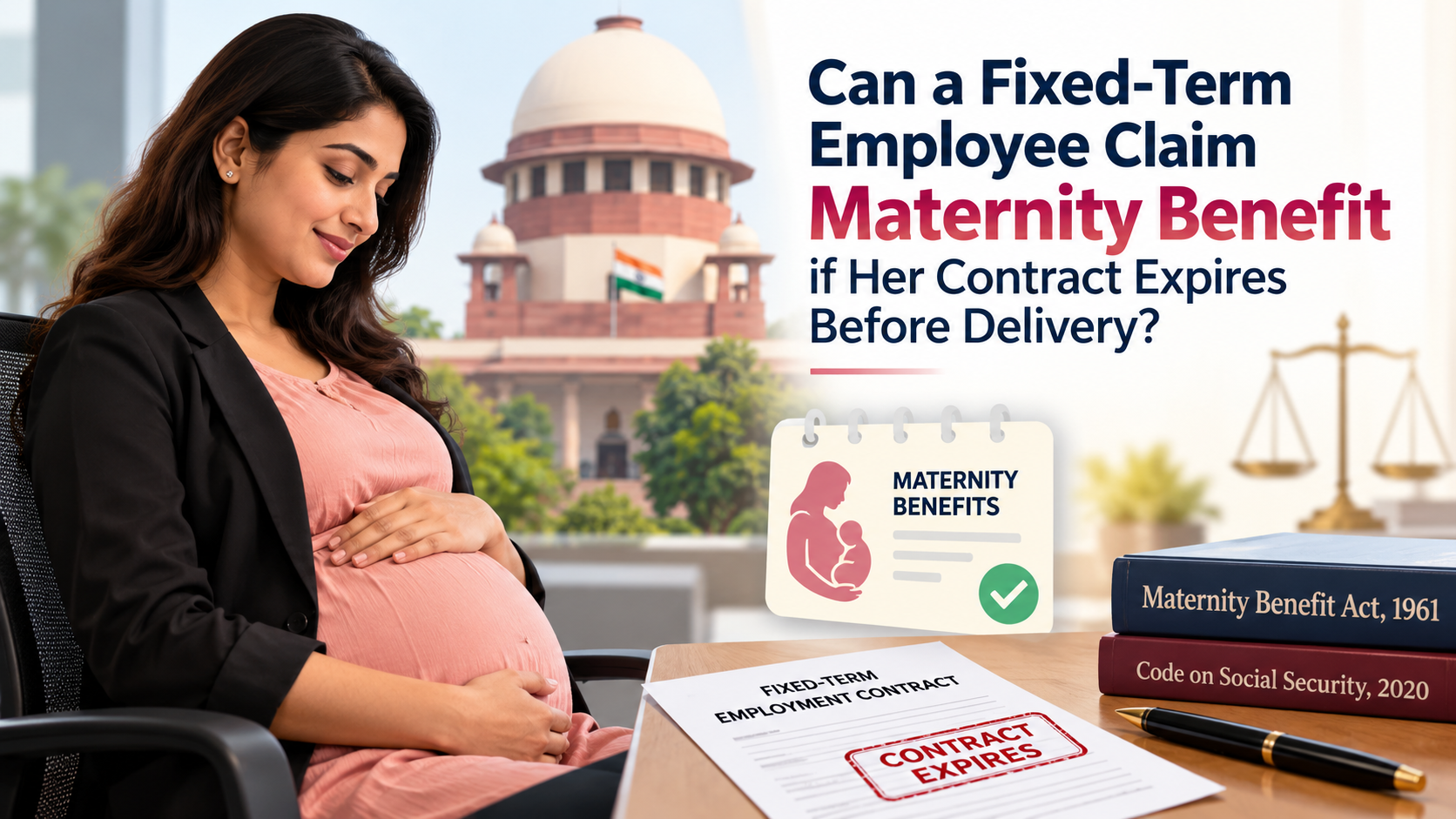
Can a Fixed-Term Employee Claim Maternity Benefit if Her Contract Expires Before Delivery?
Quick Answer
Yes. A fixed-term woman employee may remain entitled to maternity benefits even when her contract ends before delivery. Under the applicable law, satisfying the qualifying conditions is more important than the contract expiry date alone. In Dr. Kavita Yadav v. Secretary, Ministry of Health and Family Welfare (17 August 2023), the Supreme Court held that statutory maternity benefits can continue beyond the duration of contractual employment. This does not automatically extend the employment contract.
Example: A woman working on a one-year contract tells HR that she is pregnant, but her expected delivery date is after the contract expires. Can the employer refuse maternity payment because she will no longer be on the payroll? Not automatically. The employer must first examine her qualifying service, the date of her claim, the applicable maternity benefit provisions and whether ESIC coverage changes the payment route.
What does the law say about maternity benefits after a fixed-term contract ends?
The Code on Social Security, 2020 came into force as part of the four labour codes on 21 November 2025. Chapter VI covers maternity benefits in establishments to which it applies. Section 60 deals with entitlement, duration and payment; Section 62 sets out the notice and payment process; Section 68 provides protection against dismissal linked to statutory maternity absence; and Section 72 provides a complaint route.
The central rule is that a statutory maternity entitlement cannot be denied merely by pointing to a fixed contract end date when the legal conditions are met. The Supreme Court explained this under the earlier Maternity Benefit Act, 1961, whose maternity protections are now substantially reflected in Chapter VI of the Code. The individual facts and applicable current provisions must still be checked.
Supreme Court ruling: Dr. Kavita Yadav (2023)
In Dr. Kavita Yadav v. Secretary, Ministry of Health and Family Welfare Department, Civil Appeal No. 5010 of 2023, decided on 17 August 2023, an employee on a fixed-duration appointment requested maternity benefits shortly before her final contract ended. Her employer initially restricted payment to the days remaining on that contract.
The Supreme Court ruled that, once the qualifying conditions were fulfilled, maternity benefits could extend beyond the fixed employment period. It directed payment of the statutory benefits, subject to adjustment for amounts already paid. The ruling treats continuity for maternity benefit purposes differently from an automatic right to continue in the job.
Why this matters for HR: An automatic payroll cut-off at contract expiry may produce a wrong maternity-benefit decision. HR should review the entitlement before closing the employee's final settlement.
Eligibility checklist for a fixed-term employee
| Requirement | What HR should check |
|---|---|
| Applicable coverage | Confirm the establishment and employee fall under Chapter VI or the relevant ESIC maternity benefit route. |
| 80-day qualifying service | Check whether at least 80 qualifying days fall in the 12 months immediately before the expected delivery date. |
| Pregnancy and employment timing | Record when pregnancy, notice and the relevant maternity absence arose in relation to the contract period. |
| Number of surviving children | Check whether the general 26-week limit or the 12-week limit for two or more surviving children applies. |
| Service and pay records | Verify appointment and extension letters, attendance, payslips, wage details and relevant notices. |
| ESIC status | Determine whether maternity benefit is payable through the applicable ESIC scheme rather than as an employer-paid Chapter VI benefit. |
How much maternity benefit can be claimed?
- Up to 26 weeks: the general statutory maximum, with no more than eight weeks preceding the expected delivery.
- Up to 12 weeks: the maximum where the employee has two or more surviving children, with no more than six weeks preceding delivery.
- Payment basis: the average daily wage calculation laid down under Section 60, subject to applicable wage rules and the correct benefit scheme.
- Medical bonus: where the requirements of Section 64 are met and free pre-natal and post-natal care is not provided, a medical bonus may also be due.
The number of weeks is a maximum entitlement subject to legal conditions, not an automatic payment to every pregnant worker. In particular, the employee must meet the relevant eligibility and coverage requirements.
Example: Contract ends before the expected delivery date
Illustration only: An employee joined on 1 January 2026 under a fixed-term contract ending on 31 December 2026. She becomes pregnant during employment, has an expected delivery date of 15 February 2027 and meets the 80-day requirement. Her maternity entitlement should not be rejected merely because childbirth will take place after 31 December 2026. HR must separately check when the statutory claim and absence arise and assess the employer-paid or ESIC pathway.
If pregnancy first arose after the engagement ended, or if the 80-day condition is not met within the relevant 12-month window, the analysis may be different. The decision in Dr. Kavita Yadav should not be read as guaranteeing benefits in every post-employment pregnancy or as requiring contract renewal.
What should the employer do when the fixed-term contract is about to expire?
- Receive the written claim: accept the maternity notice and expected delivery documents; do not reject it automatically because of the contract end date.
- Verify coverage: decide whether the claim is governed by employer-paid maternity benefits or ESIC entitlement.
- Calculate qualifying days: check attendance and eligible days in the 12 months before expected delivery.
- Determine the benefit period: apply the 26-week or 12-week maximum as relevant.
- Check the wage calculation: calculate the statutory amount and identify any additional benefit due.
- Document the decision: keep the legal basis, payroll workings and communications on file.
- Make payment as prescribed: do not treat the contract-end date as an automatic cut-off for an accrued statutory benefit.
How can an employee claim maternity benefits after contract expiry?
- Write to HR stating the expected delivery date, the last date of employment and the statutory maternity benefit requested.
- Attach the appointment or fixed-term contract, any extension letters, salary and service evidence, and available pregnancy records.
- Ask HR to confirm the qualifying-day calculation, applicable ESIC status and payment timeline in writing.
- If the claim is rejected, request the reasons and the precise law relied upon.
- Where appropriate, approach the competent Inspector-cum-Facilitator under Section 72 of the Code on Social Security, 2020, or seek advice from a qualified labour-law professional.
Under Section 62(6), failing to give notice does not, by itself, disqualify an otherwise eligible claimant. Early written notice is still advisable because it helps establish the facts and payment schedule.
Frequently Asked Questions (FAQs)
Can a fixed-term employee get maternity benefits after her contract expires?
Yes, a qualifying employee may receive maternity benefits even if the benefit period continues beyond the contract end date. The Supreme Court recognised this principle in Dr. Kavita Yadav (2023). Eligibility, timing and the applicable benefit framework must be checked.
Is maternity benefit payable if the employment contract expires before delivery?
It can be. Contract expiry before childbirth does not automatically defeat a maternity claim. Check the 80-day qualifying condition, when the pregnancy and claim arose, and whether the claim falls under employer-paid maternity benefits or ESIC.
How many days must a fixed-term employee work to qualify for maternity benefits?
Generally, under Section 60(2) of the Code on Social Security, 2020, she must have worked for at least 80 days in the 12 months immediately before her expected delivery date, subject to applicable statutory rules.
How much maternity leave is available to a contract employee in India?
An eligible employee can generally receive up to 26 weeks of maternity benefit, with no more than eight weeks before expected delivery. For a woman with two or more surviving children, the maximum is 12 weeks, with no more than six weeks before delivery.
Does the company have to renew the fixed-term contract during maternity leave?
The judicial principle protects statutory maternity benefits; it does not automatically create a right to renewal or a permanent job. Any termination or non-renewal must also be assessed against the statutory restrictions on dismissal connected with maternity absence.
Who pays maternity benefits when the contract has ended?
Where Chapter VI employer-paid maternity benefits apply, the employer is responsible for the statutory payment. Where the woman is qualified for ESIC maternity benefit, the relevant ESI route may apply. HR should verify the applicable scheme before calculating payment.
Can the employer reject a maternity claim because notice was submitted late?
Failure to give notice does not by itself remove the right of an otherwise eligible woman under Section 62(6) of the Code on Social Security, 2020. The employee should still submit available documents and a written claim promptly.
What can a woman do if maternity benefits are refused after contract expiry?
She should send a written claim with her appointment letter, service records, expected delivery evidence and earlier communications, request a reasoned decision, and consider making a complaint to the competent Inspector-cum-Facilitator under Section 72 or seeking legal advice.
Final takeaway for HR teams and employees
Contract expiry and maternity benefit entitlement are not the same question. A fixed-term contract can reach its scheduled end, but the woman may still be entitled to statutory maternity payments if the legal conditions have been met. Employers should avoid automatic denial, verify qualifying service and ESIC status, and make a reasoned decision supported by records.
For more India labour-code guidance, explore LabourCodes360.
Legal references and further reading
- Supreme Court — Dr. Kavita Yadav judgment (17 August 2023)
- Code on Social Security, 2020 — Section 60
- Code on Social Security, 2020 — Section 62
- Code on Social Security, 2020 — Section 68
- Code on Social Security, 2020 — Section 72
- Ministry of Labour & Employment — labour codes effective 21 November 2025
Disclaimer: This article provides general information as of 28 October 2026. Applicability may vary according to the establishment, employee status, ESIC coverage and facts. It is not a substitute for individual legal advice.