
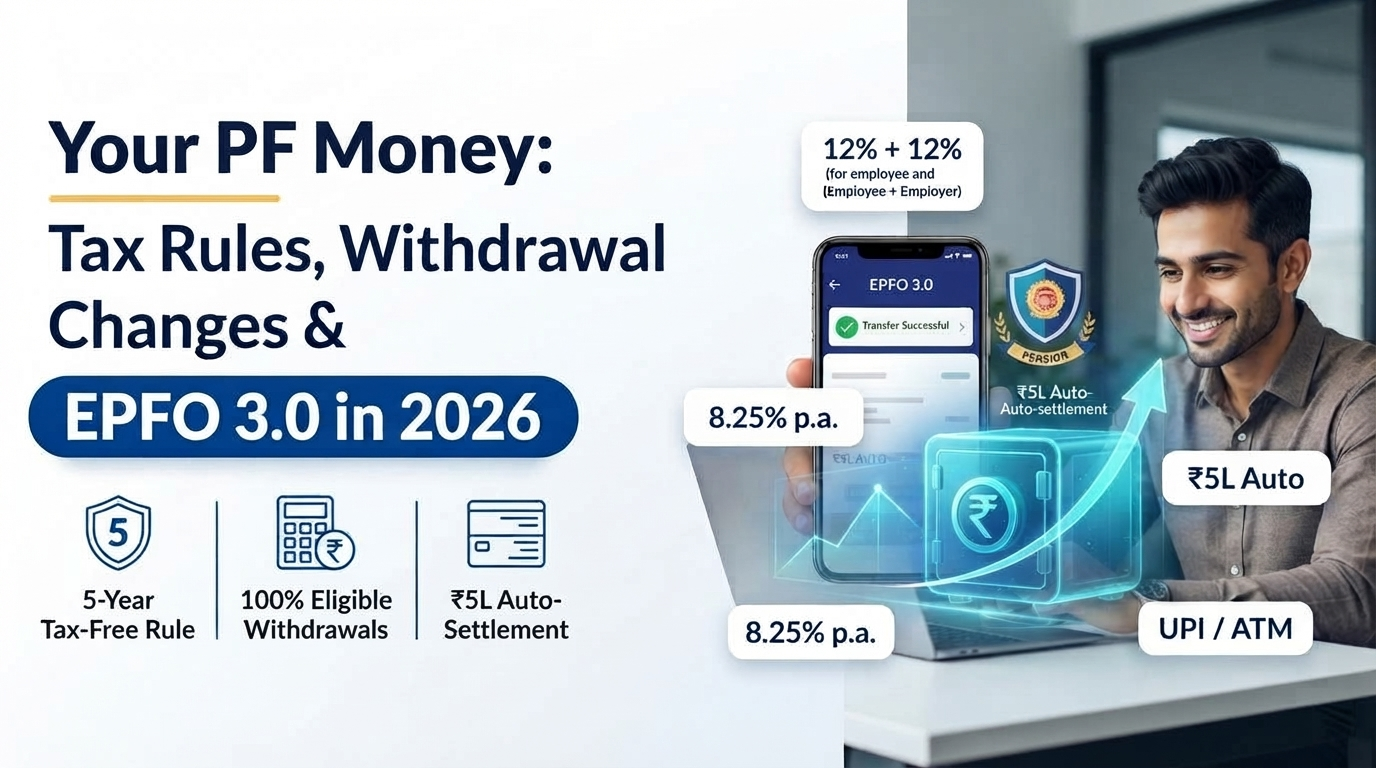
Your PF Money Explained: Tax Rules, Withdrawal Changes & EPFO 3.0
Your Employee Provident Fund (EPF) is a state-backed retirement and emergency savings engine—not just a salary deduction. Here is how the 12% employer split works under the ₹25,000 EPS ceiling, when withdrawals stay tax-free, and how EPFO 3.0 raises instant auto-settlements to ₹5 lakh.
Higher salaries send more employer money into EPF, not pension
Every month, you contribute 12% of your basic salary plus dearness allowance into your EPF account, backed by the Employees' Provident Fund Organisation. Your employer matches that 12%, but it does not all land in the same bucket.
Out of your employer's 12%, 8.33% flows into the Employees' Pension Scheme (EPS) to fund a monthly pension after retirement, and the remaining balance goes into your EPF corpus. Because EPS is calculated strictly up to a ₹25,000 salary ceiling, the employer's monthly EPS contribution is capped at ₹2,083—regardless of how high your salary rises. Every rupee of the employer's 12% above ₹2,083 flows straight into your EPF balance.
| Monthly Basic Salary | Employer 12% | To EPS (8.33%, capped) | To EPF Balance |
|---|---|---|---|
| ₹25,000 | ₹3,000 | ₹2,083 | ₹917 |
| ₹30,000 | ₹3,600 | ₹2,083 | ₹1,517 |
| ₹50,000 | ₹6,000 | ₹2,083 | ₹3,917 |
Transferring your PF across jobs protects the 5-year tax-free rule
EPF is one of the most tax-efficient retirement tools for salaried employees, but withdrawals are not automatically tax-free. The cornerstone is the 5-year continuous service rule
- 5-year continuous service: If you complete 5 years of continuous service, your EPF withdrawal is generally tax-free. Changing jobs does not reset the clock as long as you transfer your PF to the new employer instead of cashing out (for example, 3 years at one company plus 2 years at another qualifies).
- Early withdrawal penalties: Withdrawing before 5 years makes the interest taxable as income and the employer's contribution taxable as salary. If the taxable withdrawal exceeds ₹50,000, TDS is deducted upfront—though your final liability depends on your overall income tax slab. Exceptions apply for termination due to ill health or closure of the employer's business.
- Section 80C & tax regimes: Under the old tax regime, your own PF contribution qualifies for deduction within the ₹1.5 lakh Section 80C limit. Under the new tax regime, Section 80C is generally not available.
- Interest tax thresholds (8.25%): EPF interest is tax-exempt up to an employee contribution of ₹2.5 lakh per financial year when your employer also contributes (or ₹5 lakh if there is no employer contribution). Only the interest earned on the excess above that cap is taxed—not your entire PF balance.
- EPS pension vs. lump sum: With less than 10 years of eligible service, you can claim an EPS lump-sum withdrawal via Form 10C. At 10 years or more, lump-sum withdrawal is generally not allowed; instead, you qualify for a taxable monthly pension, typically from age 58.
EPFO simplified withdrawals into 3 categories—and proposed 2-month final exits
To cut down on claim rejections and procedural delays, EPFO merged 13 older partial withdrawal provisions into three broad categories: Essential Needs, Housing, and **Special Circumstances
Under the updated partial withdrawal framework, eligible members can withdraw up to 100% of their eligible PF balance (employee plus employer share) after just 12 months of service—replacing older 3-to-7-year waiting periods. Withdrawal frequency limits have also expanded to 10 times for education and 5 times for marriage (up from 3), and withdrawals under Special Circumstances no longer require stating a justification. Additionally, Form 121 replaces older Forms 15G and 15H from April 2026.
Board-approved proposals (Nov 19 meeting)
While formal scheme amendments and government notifications are still awaited, EPFO's board approved three major flexibility proposals on November 19:
- Lower minimum balance: Mandatory retained balance reduced from 25% to 10%.
- Faster unemployment exit: Waiting period for final PF withdrawal after unemployment cut from 12 months to 2 months.
- Systematic Withdrawal Plan (SWP): Retirees will be able to take monthly, quarterly, or half-yearly payouts instead of withdrawing the full corpus at once.
“It's a legal facelift, not a financial one—the real game changer is EPFO 3.0.”
EPF Scheme 2026 & EPFO 3.0: What actually changes for you
In June 2026, the government replaced the 1952 EPF framework with the EPF Scheme 2026. For everyday employees, your 12% contribution, employer match, 8.25% interest rate, and tax rules remain unchanged; the overhaul focuses on cleaner legal structure, more precise interest calculation rules, and tighter oversight of private PF trusts et="_blank" rel="noopener noreferrer">).
Day-to-day access improves under EPFO 3.0. The auto-settlement limit has jumped from ₹1 lakh to ₹5 lakh, enabling faster automated approvals without manual sign-off. UPI and ATM-based withdrawals are also rolling out gradually, though they are not yet live everywhere—check the EPFO app before counting on instant access for urgent needs.
Bottom line: EPF builds disciplined, state-backed, tax-efficient savings and a guaranteed pension floor, but it works best as the safe foundation of a broader retirement portfolio alongside instruments like NPS.
Frequently asked questions
How does the 12% employer contribution split between EPF and EPS?
You contribute 12% of your basic salary plus dearness allowance to EPF, and your employer matches 12%. However, 8.33% of the employer's share goes to the Employees' Pension Scheme (EPS), capped at a ₹25,000 salary ceiling—meaning EPS never receives more than ₹2,083 per month. The remainder of the employer's 12% goes into your EPF account.
When is an EPF withdrawal completely tax-free?
Your EPF withdrawal is generally tax-free after 5 years of continuous service. Continuous service carries across job changes as long as you transfer your PF to your new employer instead of withdrawing it. Exceptions also apply for termination due to ill health or closure of the employer's business. If you withdraw before 5 years, interest and employer contributions become taxable, and TDS applies if the taxable withdrawal exceeds ₹50,000.
Is EPF interest taxable for high earners?
EPF currently earns 8.25% interest, calculated monthly and credited annually. It is tax-exempt up to an employee contribution of ₹2.5 lakh per financial year when the employer also contributes (or ₹5 lakh if there is no employer contribution). Only the interest attributable to contributions above that threshold is taxed—not your entire PF interest.
What changed in the new EPFO partial withdrawal rules?
EPFO merged 13 older withdrawal provisions into three categories: Essential Needs, Housing, and Special Circumstances. Eligible members can withdraw up to 100% of their eligible PF balance (employee plus employer share) after 12 months of service, make up to 10 withdrawals for education and 5 for marriage, and apply under Special Circumstances without specifying a reason.
What additional withdrawal changes did the EPFO board approve on November 19?
At its November 19 board meeting, EPFO approved three proposals (awaiting formal scheme amendments and notifications): reducing the mandatory minimum PF balance from 25% to 10%, cutting the waiting period for final withdrawal after unemployment from 12 months to 2 months, and introducing a Systematic Withdrawal Plan (SWP) for retirees with monthly, quarterly, or half-yearly payouts.
What is EPFO 3.0 and what is the auto-settlement limit?
EPFO 3.0 modernizes claim processing by raising the auto-settlement limit from ₹1 lakh to ₹5 lakh, allowing eligible smaller claims to be approved automatically without manual sign-off. UPI and ATM-based withdrawals are also being rolled out gradually, though members should check the EPFO app before relying on them for urgent needs.
Does the EPF Scheme 2026 change my 12% contribution or tax rules?
No. Replaced in June 2026 to modernize the 1952 framework, the EPF Scheme 2026 is primarily a legal and administrative update—introducing more precise interest calculation rules and stricter oversight of private PF trusts—while keeping your 12% contribution, 8.25% interest, and tax rules unchanged.