HRMThread | Blog | 5 min Read
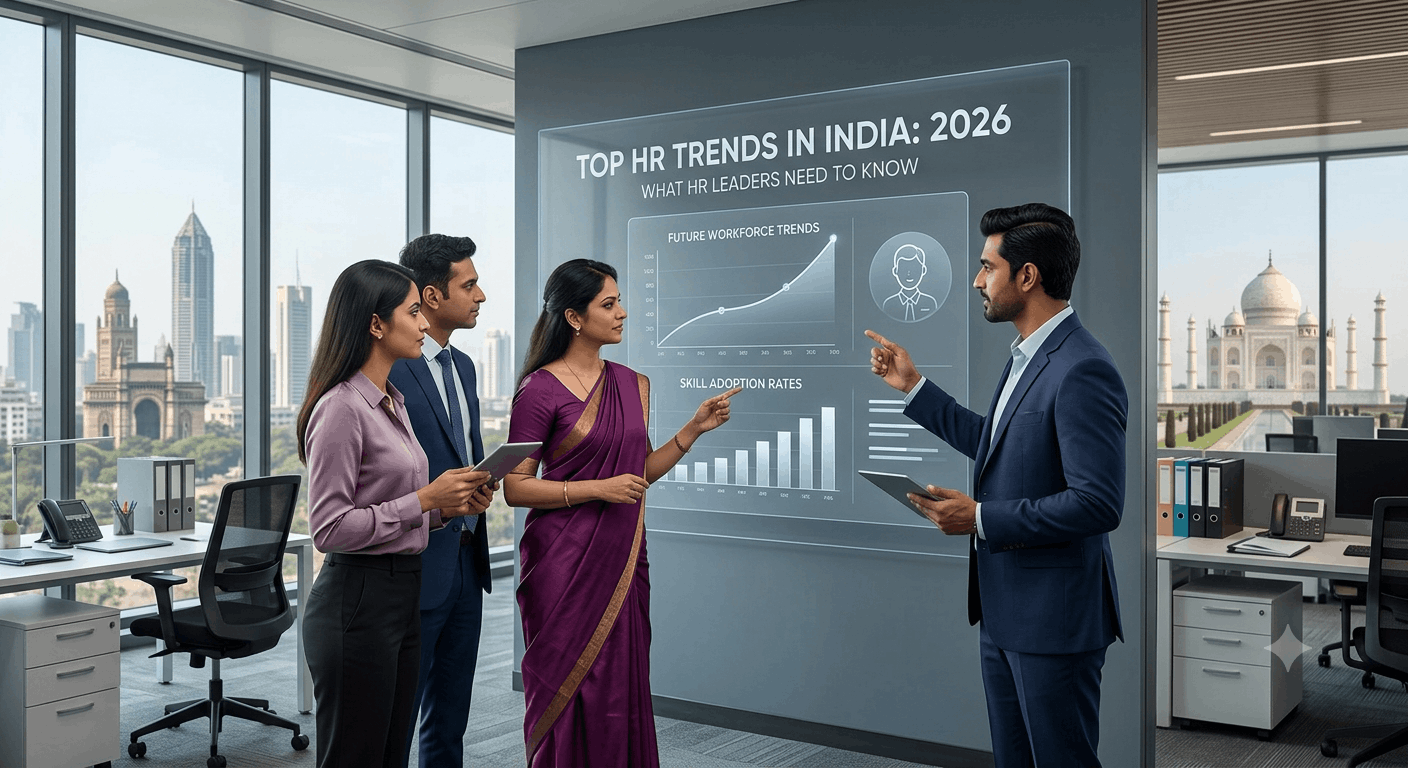
Top HR Trends in India 2026:
What HR Leaders Need to Know
The workplace is changing quickly, and HR trends in India 2026 reflect a major shift in how organisations manage people, technology, compliance, and productivity.
HR is no longer limited to recruitment, attendance, payroll, and employee documentation. Today, HR leaders are expected to contribute directly to business growth, improve employee experience, manage changing compliance requirements, use workforce data, and prepare employees for new technologies.
Artificial intelligence, automation, skills-based hiring, employee self-service, HR analytics, and continuous learning are becoming increasingly important parts of modern HR strategies.
So, what should HR leaders in India focus on in 2026?
Here are the key HR trends shaping the future of work in India.
1. AI in HR Will Move from Experiment to Everyday Use
Artificial intelligence is one of the biggest HR trends in 2026.
Many HR teams are moving beyond simply experimenting with AI tools and are looking at practical ways to use AI in everyday processes.
AI can support HR teams with:
- Recruitment and candidate screening
- Employee queries
- Job description creation
- HR documentation
- Workforce analytics
- Learning recommendations
- Employee onboarding
- Performance insights
- HR reporting
The goal is not to replace HR professionals. Instead, AI can take care of repetitive tasks and allow HR teams to spend more time on employee engagement, decision-making, culture, and strategic workforce planning.
HR leaders should start by identifying repetitive, time-consuming processes where automation can provide measurable benefits.
2. Skills-Based Hiring Will Gain More Importance
Recruitment is gradually moving beyond degrees, job titles, and years of experience.
As technology changes job responsibilities, organisations need people who can demonstrate relevant skills and adapt to new situations.
This makes skills-based hiring an important HR trend for 2026.
Companies are increasingly looking at:
- Technical skills
- Communication
- Problem-solving
- Adaptability
- Digital skills
- AI literacy
- Leadership capabilities
- Willingness to learn
For HR teams, this means recruitment processes may need to change as well. Job descriptions, interviews, assessments, and career development programmes should focus more on what an employee can actually do.
3. Continuous Employee Upskilling Will Become Essential
The skills employees need today may not be the same skills they need two years from now.
AI, automation, data analytics, cybersecurity, and other technologies are changing workplaces rapidly. As a result, organisations cannot depend only on traditional one-time training programmes.
Continuous learning and employee upskilling will become an important part of HR strategy.
HR leaders can encourage continuous development through:
- Short online learning programmes
- Internal workshops
- Mentoring
- Cross-functional projects
- Leadership development
- Technology training
- Skill assessments
The objective should be to create a workforce that can learn and adapt continuously.
4. Employee Experience Will Become a Strategic Priority
Employees increasingly expect workplace processes to be simple and convenient.
They want quick access to payslips, leave balances, attendance records, tax documents, company policies, and other HR information without having to contact HR for every small request.
This is driving greater adoption of employee self-service (ESS) platforms.
Modern HR technology can allow employees to manage routine activities through a web or mobile application.
For HR teams, this can reduce administrative workload while giving employees a faster and more convenient experience.
The future of employee experience is not just about benefits and workplace culture. It is also about making everyday HR interactions easier.
5. HR Analytics Will Drive Better Decisions
Another major HR trend in India 2026 is the growing importance of workforce data.
Instead of relying only on assumptions, HR leaders can use data to understand what is happening across their workforce.
Important HR metrics include:
- Employee turnover
- Absenteeism
- Hiring performance
- Workforce cost
- Overtime
- Employee productivity
- Training effectiveness
- Salary trends
- Department-wise headcount
The next stage is predictive HR analytics—using historical and current data to identify potential workforce risks and opportunities.
For example, instead of simply reporting employee attrition, HR can analyse which departments, locations, experience levels, or salary bands are experiencing higher turnover.
This makes HR data more useful for business decision-making.
6. HR Compliance Will Remain a Key Focus
Compliance continues to be one of the most important responsibilities of HR and payroll teams in India.
Changing labour regulations, statutory requirements, payroll rules, employee documentation, and reporting requirements mean HR teams need reliable processes for managing compliance.
Manual processes can increase the possibility of errors, especially as organisations grow.
HR leaders should therefore focus on:
- Accurate employee records
- Correct payroll calculations
- Statutory deductions
- Compliance tracking
- Proper documentation
- Regular updates on regulatory changes
- Audit-ready reports
Using HR and payroll software can help organisations reduce manual work and improve consistency in compliance-related processes.
7. Performance Management Will Become More Continuous
The traditional annual appraisal is gradually being supplemented by more regular performance conversations.
Employees want to know where they stand instead of waiting an entire year for feedback.
Modern performance management can include:
- Regular one-to-one meetings
- Quarterly goal reviews
- KPI tracking
- Continuous feedback
- Employee recognition
- Development plans
This approach allows managers to identify challenges earlier and give employees clearer direction.
For HR leaders, the focus should be on creating a performance culture rather than treating appraisal as an annual administrative exercise.
8. Flexible Work Will Become More Role-Based
The remote-versus-office debate is becoming more nuanced.
Not every role requires the same working model. Some jobs can be performed remotely, while others require physical presence, teamwork, customer interaction, or operational support.
As a result, organisations may increasingly adopt role-based flexible work policies.
HR leaders will need to balance:
- Employee expectations
- Productivity
- Collaboration
- Business requirements
- Company culture
- Employee retention
The key question is no longer simply “Should employees work remotely?”
It is “What working model allows this role and this employee to perform effectively?”
9. HR Technology Will Become More Integrated
Many organisations still use separate systems for attendance, payroll, recruitment, employee records, performance, and reporting.
When these systems do not communicate with each other, HR teams often have to enter the same information multiple times.
This is why integrated HR software is becoming increasingly valuable.
A connected HR system can bring processes such as:
Attendance → Payroll → Compliance → Employee Self-Service → Reports → Analytics
into one ecosystem.
This can reduce repetitive administrative work, improve data accuracy, and give HR leaders a more complete view of their workforce.
10. Employee Data Security Will Matter More
HR departments handle highly sensitive employee information, including salary details, bank information, identity documents, attendance records, and performance data.
As organisations adopt cloud HR software, AI tools, mobile applications, and other digital platforms, protecting employee information becomes increasingly important.
HR leaders should consider:
- Role-based access
- Data security
- User permissions
- Audit trails
- Secure data storage
- Vendor security practices
- Employee privacy
Technology should make HR more efficient without compromising employee trust.
What Should HR Leaders Do in 2026?
HR leaders do not need to adopt every new technology or trend immeddiately. Instead, focus on the arears that can create the greatest impact. Start with these fice priorities:
Automate repetitive HR processes
Identify manual tasks that consume significant HR time.
Invest in employee self-service
Give employees easy access to everyday HR information.
Build a skills-focused workforce
Identify the skills your organisation will need in the next few years.
Use HR data for decision-making
Track meaningful workforce metrics instead of relying only on assumptions.
Keep compliance and employee data security at the centre
Technology should improve efficiency while maintaining accuracy, privacy, and compliance.
The Future of HR in India
The biggest HR trend in India in 2026 is not one particular technology. It is the transformation of HR from an administrative function into a more strategic, technology-enabled business function.
AI will automate repetitive work. HR analytics will support better decisions. Skills-based hiring will change recruitment. Employee self-service will improve employee experience. Continuous learning will help organisations remain competitive.
But technology alone will not create better workplaces.
The most successful HR teams will be those that combine technology with human judgement, empathy, communication, and strong leadership.
For HR leaders, 2026 is the right time to review existing processes, identify opportunities for automation, strengthen workforce capabilities, and build an HR strategy that is ready for the future.
Frequently Asked Questions About HR Trends in India 2026
What are the top HR trends in India in 2026?
The major HR trends include AI in HR, skills-based hiring, continuous upskilling, employee experience, HR analytics, HR automation, integrated HR software, flexible work, performance management, and stronger compliance management.
How is AI changing HR in 2026?
AI is helping HR teams automate repetitive tasks, support recruitment, answer employee queries, analyse workforce data, and improve HR decision-making. Human oversight remains important for sensitive employee-related decisions.
Why is HR software important in 2026?
HR software can help organisations automate attendance, payroll, employee self-service, compliance, reporting, and other HR processes. Integrated systems can also reduce duplicate data entry and manual errors.
What should HR leaders focus on in 2026?
HR leaders should focus on automation, employee experience, workforce analytics, skills development, compliance, data security, and aligning HR strategy with broader business goals.
Is employee self-service becoming important for Indian companies?
Yes. Employee self-service can give employees direct access to information such as payslips, attendance, leave, tax documents, and HR requests while reducing routine administrative work for HR teams.

Ready to transform your HR & payroll?
Join thousands of businesses using HRMThread — the best HRMS payroll software in India.