
Can Salary Deductions Exceed 50% When Several Recoveries Fall Due Together?
What does the 50% deduction limit mean?
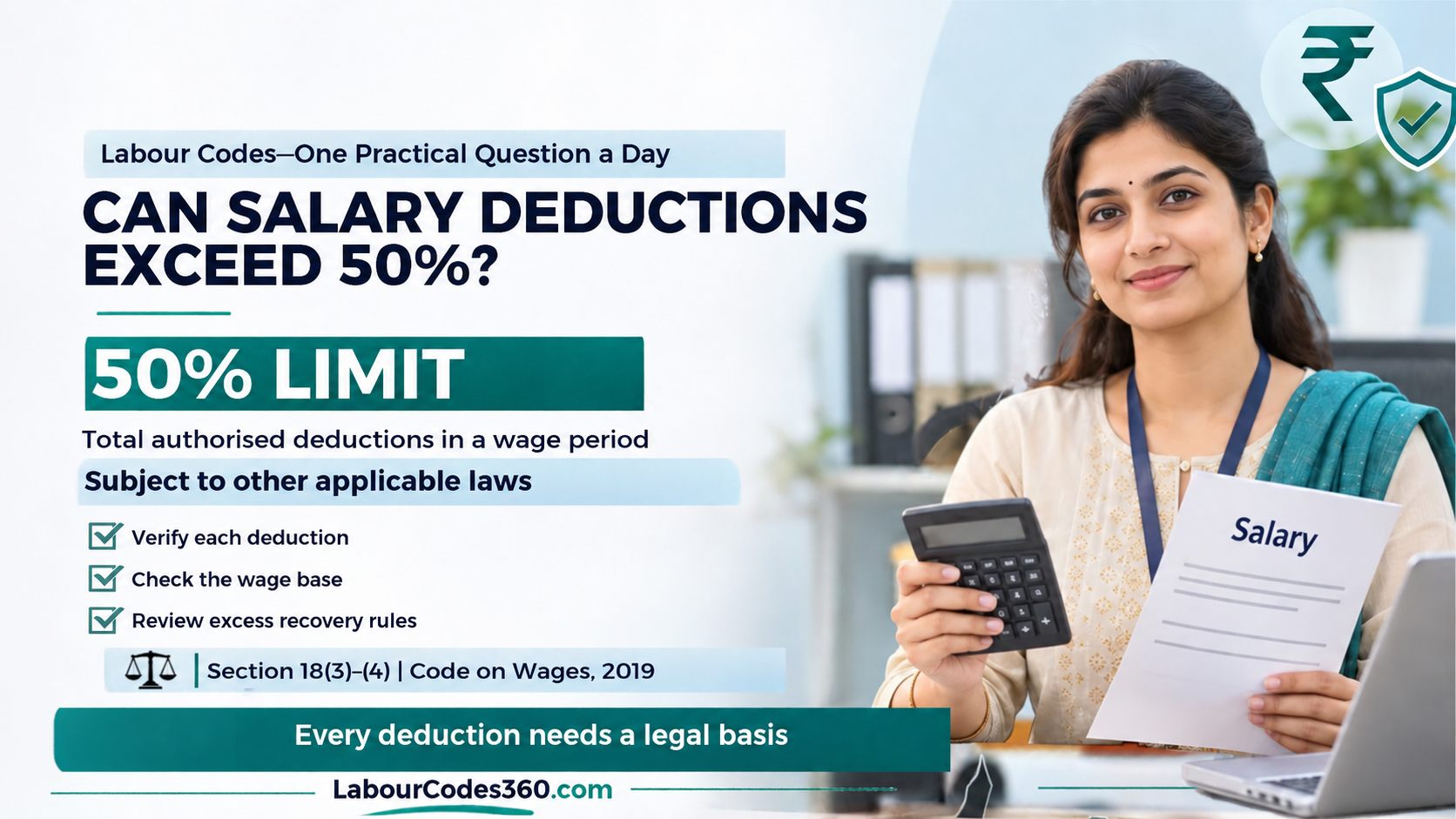
The limit applies to the total of deductions authorised under Section 18(2) during a wage period. It is not a separate 50% allowance for each type of recovery.
For example, an employer should not treat a 50% limit for an advance recovery and another 50% limit for a loan recovery as separate limits. The authorised deductions must be considered together against the employee’s wages for the relevant period.
Example: several recoveries in one month
Suppose an employee’s wages for a monthly wage period are ₹30,000. The maximum total deduction under this 50% cap is ₹15,000.
If several authorised recoveries add up to ₹19,000, the employer cannot deduct the full ₹19,000 in that wage period under Section 18. The excess ₹4,000 must be carried forward and recovered in instalments in succeeding wage periods, while respecting the applicable cap for each month.
This example assumes ₹30,000 is the relevant wage amount for the calculation. The legal definition of “wages” and the employee’s specific payroll facts may affect the calculation.
Which deductions may be covered?
Section 18(2) permits deductions only for specified purposes and subject to the Code and applicable rules. These include, among others:
- Fines imposed in accordance with the law
- Absence from duty
- Certain losses or damage directly attributable to an employee’s neglect or default
- House accommodation and certain authorised amenities or services
- Recovery of advances, overpaid wages and specified loans
- Income tax, other statutory levies payable by the employee, or amounts ordered by a competent court or authority
- Contributions to certain statutory social security funds or schemes
- Other listed deductions, where the required conditions are met
An employer should check that each individual deduction is legally authorised before applying the 50% cap. The cap does not, by itself, make an otherwise unauthorised deduction lawful. See Section 18 of the Code on Wages.
How should the excess be recovered?
Section 18(4) provides for excess deductions to be recovered in the prescribed manner. Rule 13 of the Wages (Central) Rules, 2026 provides that an amount exceeding 50% is carried forward and recovered from wages in succeeding wage periods, in instalments, so that recovery in any month does not exceed 50% of the employee’s wages for that month. See the Wages (Central) Rules, 2026.
Employers should maintain a clear record of the deduction, its legal basis, the amount carried forward and the instalments recovered. Employees who believe deductions are unauthorised or incorrectly calculated should review their wage slip and seek clarification from the employer or the appropriate labour authority.
Does the 50% rule apply to every salary component?
The deduction cap is stated as a percentage of wages. That term has a legal definition under the Code on Wages. It should not automatically be treated as identical to take-home pay, gross salary or CTC in every case.
The Ministry of Labour and Employment’s FAQ material separately discusses how certain remuneration components are considered for the 50% wage-definition calculation. That calculation is distinct from the Section 18 limit on deductions. Employers should apply the statutory definition and current rules to the facts of the employee’s pay structure. See the Ministry’s Additional FAQs on Labour Codes.
Employer compliance checklist
Before processing multiple recoveries in the same wage period, an employer should:
- Confirm that each deduction is permitted under Section 18 and satisfies any applicable conditions.
- Calculate the employee’s wages for the relevant wage period using the statutory definition.
- Add together the deductions covered by Section 18(2).
- Keep the total within the 50% limit for that wage period.
- Carry forward any excess and recover it in instalments within the limit for succeeding periods.
- Keep records that explain the deduction and any carried-forward balance.
Frequently asked questions
Can an employer deduct more than 50% of wages if an advance and loan are both due?
Generally, no. The 50% cap applies to the combined authorised deductions under Section 18(2) for the wage period. If those deductions exceed the cap, the excess is carried forward for recovery in later periods in instalments.
Is the 50% limit applied separately to each deduction?
No. The limit applies to the total amount of deductions covered by Section 18(2) during the wage period. It is not a separate 50% limit for every recovery category.
What happens to the amount above the 50% limit?
The excess is carried forward and recovered in succeeding wage periods. Under Rule 13 of the Wages (Central) Rules, 2026, recovery in any month must be arranged so that it does not exceed 50% of that month’s wages.
Does the cap make every salary deduction valid if the total is below 50%?
No. Each deduction must first be authorised under the Code and comply with applicable conditions. The 50% cap is a maximum limit, not general permission to make deductions.
Is the cap calculated on take-home salary?
The law refers to the employee’s “wages.” Take-home pay, gross salary, CTC and statutory wages can differ. The calculation should use the applicable legal definition of wages and the facts of the employee’s pay structure.
Where can an employee check the deductions made?
The employee can review the wage slip and ask the employer for an itemised explanation of each deduction, including the amount carried forward. The Ministry’s materials state that wage slips should be provided electronically or physically on or before wage payment. See the Ministry of Labour and Employment factsheet.
Legal references
- Code on Wages, 2019, Section 18: authorised deductions, 50% cap and excess recovery.
- Wages (Central) Rules, 2026, Rule 13: recovery of deductions exceeding the 50% limit.
The applicable rules may depend on which government is the “appropriate Government” for the establishment and on relevant state rules. Employers should check the rules applicable to their establishment.
This article is for general information and is not a substitute for advice on a specific payroll or employment dispute.