Case category: High Court Judgement | Social Security Code, 2020
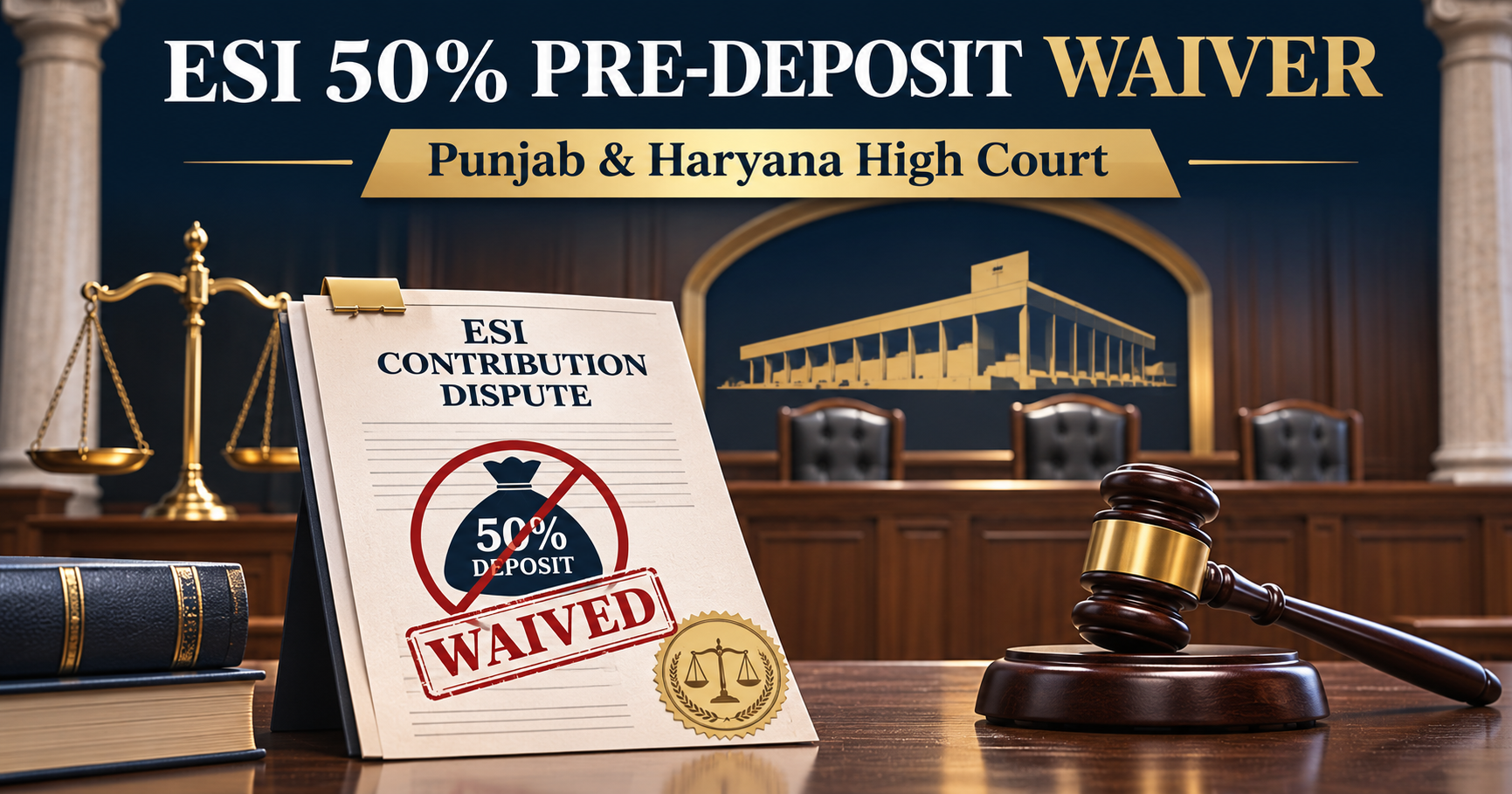
ESI Court Can Completely Waive the 50% Pre-Deposit Requirement Under the Social Security Code: Punjab & Haryana High Court
Quick answer: Section 49(2) of the Code on Social Security, 2020 permits the Employees’ Insurance Court to waive or reduce the 50% pre-deposit for reasons recorded in writing. The Punjab and Haryana High Court upheld a complete waiver in the specific cases before it, but did not remove the general pre-deposit requirement.
Court: Punjab and Haryana High Court, Chandigarh
Decision date: 1 September 2026
What did the Punjab and Haryana High Court hold?
The Punjab and Haryana High Court declined to interfere with the Employees’ Insurance Court’s orders granting a complete waiver of the 50% pre-deposit in three connected ESI contribution disputes.
The Court held that Section 49(2) of the Code on Social Security, 2020 expressly gives the Employees’ Insurance Court power to waive or reduce the deposit for reasons recorded in writing. Because the statute does not prescribe a minimum deposit after reduction, the Court found no basis to read a minimum threshold into the provision.
The ruling is fact-specific. It does not make waiver automatic, remove the ordinary 50% pre-deposit requirement or decide whether the underlying ESI assessments were correct.
Case details
- Court: Punjab and Haryana High Court at Chandigarh
- Judge: Justice Kirti Singh
- Decision date: 1 September 2026
- Connected matters: CWP Nos. 27421, 27146 and 27176 of 2026
- Provision considered: Section 49(2), Code on Social Security, 2020
- Subject: Waiver of the pre-deposit required to raise an ESI dispute before the Employees’ Insurance Court
Background of the dispute
The dispute arose from three contribution assessments made by the Employees’ State Insurance Corporation under Section 45A of the Employees’ State Insurance Act, 1948. The assessments covered different periods and included contribution, interest and costs.
The establishment challenged the assessments through statutory appeals under Section 45AA. Those appeals were dismissed because the required 25% pre-deposit had not been made, so the assessment issues were not decided on their merits. ESIC then initiated recovery proceedings, including recovery from the establishment’s bank accounts.
The establishment approached the Employees’ Insurance Court at Jhajjar, challenging the demands and asking the Court to waive the 50% pre-deposit under Section 49(2) of the Code on Social Security, 2020.
The Employees’ Insurance Court initially granted interim relief without hearing ESIC. The High Court set aside those earlier orders and sent the matters back for fresh consideration after hearing both sides. It also observed that difficulty in paying salaries could not, by itself, be the sole basis for waiving the pre-deposit.
After hearing both sides on remand, the Employees’ Insurance Court again granted a complete waiver on 16 May 2026. ESIC challenged those orders before the High Court.
Why did the High Court uphold the waiver?
The High Court noted that the later waiver orders had been passed after the parties were heard and after the Employees’ Insurance Court reconsidered the facts. It found that the decision was not based only on the establishment’s claim that it needed funds to pay salaries.
The underlying disputes included questions about which establishment the assessments related to, whether the inspecting authority had acted within its jurisdiction, and how interest had been calculated during long periods of delay. The High Court considered these relevant circumstances when deciding whether the Employees’ Insurance Court’s discretion had been exercised on a legally impermissible basis.
The High Court was exercising supervisory jurisdiction under Articles 226 and 227 of the Constitution. It explained that this jurisdiction is not a routine appeal against every interlocutory order. Interference would be justified if the lower court’s decision were arbitrary, perverse, capricious, based on irrelevant considerations or contrary to settled legal principles. The High Court found no such ground in these cases.
How does Section 49(2) treat the 50% pre-deposit?
Section 49(2) generally requires an employer disputing ESI contributions or other dues before the Employees’ Insurance Court to deposit 50% of the amount claimed. Its proviso allows the Court, for reasons recorded in writing, to waive or reduce the amount.
The High Court compared this wording with other statutes that set a minimum amount below which a pre-deposit cannot be reduced. It found that Section 49(2) does not specify such a minimum floor. The Court therefore held that it should not introduce a minimum deposit that the legislature did not include.
At the same time, the Court made clear that the pre-deposit requirement continues to exist. The power to waive or reduce it must be exercised judicially, on relevant facts and with reasons recorded in writing.
What the judgment does not decide
- It does not abolish the general 50% pre-deposit requirement.
- It does not give every employer an automatic right to a complete waiver.
- It does not finally decide whether the ESI contribution assessments were valid.
- It does not determine the final liability for contribution or interest.
- It does not order a refund of amounts already recovered; the refund applications remained pending before the Employees’ Insurance Court.
Practical implications for employers
An employer seeking waiver or reduction should file a specific application before the Employees’ Insurance Court and support it with relevant facts and documents. Depending on the case, relevant material may include the assessment history, records identifying the establishment and employees concerned, jurisdictional objections, the history of appeal proceedings, recovery details and the basis for disputing interest.
The judgment highlights the importance of a reasoned, case-specific decision. A general statement of financial difficulty, without other supporting circumstances, may not be enough. Employers should obtain legal advice about the applicable procedure and evidence for their own dispute.
Frequently asked questions
Can an Employees’ Insurance Court waive the 50% pre-deposit under Section 49(2)?
Section 49(2) allows the Employees’ Insurance Court, for reasons recorded in writing, to waive or reduce the 50% pre-deposit. The Punjab and Haryana High Court upheld the exercise of that discretion in the specific cases before it. Waiver is not automatic.
What did the Punjab and Haryana High Court decide?
On 1 September 2026, the High Court dismissed ESIC’s three connected writ petitions and declined to interfere with the Employees’ Insurance Court’s reasoned orders granting complete waiver of the pre-deposit. The underlying contribution and interest disputes remained undecided.
Does this judgment remove the 50% ESI pre-deposit requirement?
No. The 50% pre-deposit remains the general statutory requirement. Section 49(2) gives the Employees’ Insurance Court discretion to waive or reduce it for reasons recorded in writing.
Was financial hardship alone enough to justify the waiver?
No. An earlier order had been set aside after salary-payment hardship was treated as the sole basis for relief. On reconsideration, the Employees’ Insurance Court heard both sides and considered case-specific issues, including disputes about assessment attribution, jurisdiction and delay in calculating interest.
Did the High Court decide whether the ESI contribution assessments were correct?
No. The High Court clarified that the assessment liability, contribution amounts, interest and refund applications remained open before the Employees’ Insurance Court. Its decision concerned whether the interim pre-deposit waiver orders warranted supervisory interference.
Which case did the Punjab and Haryana High Court decide?
The common order dated 1 September 2026 disposed of CWP Nos. 27421, 27146 and 27176 of 2026, concerning connected proceedings before the Employees’ Insurance Court at Jhajjar.